Best OEM Rubber Seal O Ring Factory in China?
Choosing the best OEM Rubber Seal O-Ring Factory in China requires more than comparing unit prices. A reliable supplier should understand material behavior, tooling accuracy, compression set, and long-term sealing performance. Dr. Robert P. Flitney, a respected sealing engineer and author, stated, “The correct seal design begins with understanding the application, not merely selecting a rubber compound.” That principle remains highly practical.
A capable factory should provide clear material options, including NBR, EPDM, silicone, FKM, and specialized compounds. Each material reacts differently to heat, pressure, oil, chemicals, and outdoor exposure. Ask whether the factory controls mixing, molding, trimming, inspection, and packaging internally. Strong process control reduces inconsistent dimensions and hidden defects.
Look for ISO 9001 systems, documented inspection records, and traceable batch numbers. Automotive projects may also require IATF 16949 experience. Aerospace, medical, or food-related applications demand additional compliance evidence. Certificates alone are not enough. Review test methods, sample reports, and actual production references.
A serious OEM partner should support drawings, prototype development, tooling revisions, and tolerance discussions. Ask for samples before approving mass production. Inspect flash, surface marks, hardness, inner diameter, and cross-section carefully. Small defects can become expensive leaks.
The best factory is not always the cheapest one. That sounds obvious, yet many buyers still overlook it. Delivery stability, communication, mold ownership, and corrective-action speed matter just as much. A supplier may appear impressive online but struggle with simple traceability. Careful evaluation is essential, because a perfect quotation cannot repair a poor seal in the field.
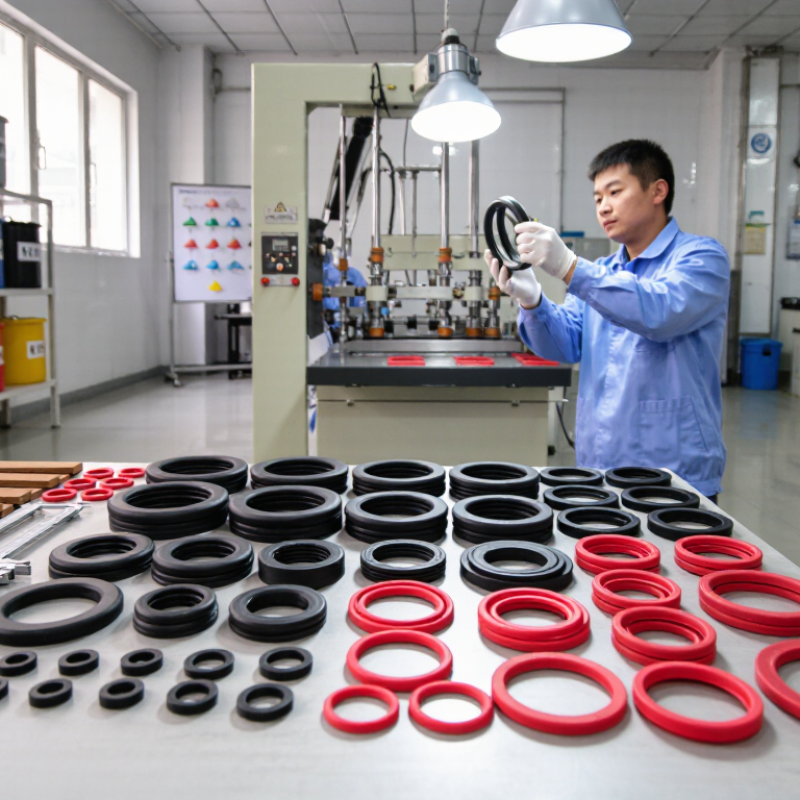
What Defines the Best OEM Rubber Seal O-Ring Factory in China?
The best OEM rubber seal O-ring factory in China is defined by evidence, not attractive promises. Experienced engineers should understand sealing pressure, temperature, media exposure, and installation conditions. They must recommend suitable compounds instead of copying a customer’s drawing blindly.
A capable factory controls mixing, molding, trimming, and inspection under documented procedures. Material batches should be traceable from incoming rubber to packed O-rings. Dimensional checks need calibrated equipment, while compression set, hardness, tensile strength, and aging tests should match the application. Samples should be approved before mass production. Clear communication matters too, especially when tolerances or drawings seem incomplete.
Tips: Ask for sample reports, process records, and a realistic production schedule. Check whether the factory explains possible failure points. A reliable supplier will discuss tooling life, storage conditions, and inspection limits openly. It should also protect drawings and customer data through practical internal controls. No factory is perfect. A thoughtful review may reveal small gaps, such as slow feedback or limited test capacity. That is not always a rejection point, but the response matters. Does the team acknowledge the weakness and offer a measurable improvement? On-site audits, trial orders, and regular quality reviews can expose problems before they become costly field failures.
What OEM Design, Prototyping, and Customization Services Should You Expect?
Choosing the best OEM rubber seal O-ring factory requires more than comparing prices. The right partner should understand your drawing, working temperature, pressure, chemicals, and assembly method. A capable engineering team reviews these details before suggesting rubber compounds or profile changes. It should also check sealing gaps, compression levels, and dimensional tolerances.
Ask how the factory handles OEM design and prototyping. Engineers should provide 2D drawings, 3D models, material options, and clear design feedback. Prototype samples should come from production-intent tooling when possible. This reveals flash, shrinkage, surface marks, and assembly problems early. A first prototype is rarely perfect. That is normal.
Customization should include compound development, color control, hardness selection, tooling adjustments, packaging, and labeling. Reliable suppliers explain their inspection process, including dimensional checks, hardness testing, tensile results, and compression set data. Request material certificates and batch traceability. These records support consistent purchasing and quality reviews.
Communication matters too. Technical questions should receive specific answers, not vague promises. The factory should confirm lead times, sample approval steps, mold ownership, and revision control in writing. An experienced supplier may challenge an unnecessary tolerance or recommend a simpler groove design. That can reduce cost, although the advice still needs verification through testing. Ask for pilot-run results before approving larger production. Small details matter.
OEM Rubber Seal O-Ring Services: Typical Project Timeline
Typical planning ranges for an OEM O-ring project, from design review to production validation. Actual timing depends on geometry, rubber compound, tooling complexity, tolerances, and testing requirements.
The ranges shown are common industry planning benchmarks and are not quotations from any specific manufacturer.
How to Compare Pricing, Lead Times, Communication, and After-Sales Support
Choosing the best OEM rubber seal O-ring factory in China requires more than comparing unit prices. Request a full quotation showing tooling, material, inspection, packaging, and shipping costs. A cheaper seal may use an unsuitable compound or exclude mold maintenance. Ask for hardness tolerance, temperature range, compression set data, and compliance documents. ISO 3601 dimensions are useful, but application conditions still matter.
Lead time should be written as separate stages: drawing approval, tooling, first samples, mass production, and dispatch. In practice, communication often reveals factory discipline. A reliable supplier answers technical questions with drawings, test reports, and clear dates. Vague replies create hidden delays. McKinsey Global Institute reported that major supply chain disruptions may occur every 3.7 years, with substantial long-term profit exposure. That makes backup capacity and safety stock worth discussing, even for small orders. I would ask for weekly updates and a named engineer, not only a sales contact.
After-sales support must cover defective batches, replacement timing, root-cause analysis, and evidence retention. Request sample approval records and batch traceability. A written corrective-action process is stronger than “we will solve it.” Some factories promise too much. That is a warning. A trial order can test dimensional consistency, packaging quality, response speed, and honesty before larger production begins.
Best OEM Rubber Seal O Ring Factory in China? - How to Compare Pricing, Lead Times, Communication, and After-Sales Support
| Comparison Criteria | Anonymous OEM Rubber Seal Factory Comparison |
| Factory A | Factory B | Factory C | Factory D | Factory E |
| Typical Product Focus | Standard O-rings and hydraulic seals | Custom molded rubber components | Food-grade and potable-water seals | High-temperature and chemical-resistant seals | High-volume automotive sealing parts |
| Common Rubber Materials | NBR, EPDM, FKM, silicone | NBR, EPDM, FKM, CR, silicone | EPDM, silicone, FKM | FKM, FFKM, EPDM, PTFE-encapsulated | NBR, HNBR, EPDM, FKM |
| Indicative Unit Price for Standard O-Ring* | US$0.012–0.085 | US$0.018–0.110 | US$0.025–0.135 | US$0.080–0.950 | US$0.010–0.075 |
| Typical Minimum Order Quantity | 1,000–5,000 pieces | 500–3,000 pieces | 2,000–10,000 pieces | 100–1,000 pieces | 10,000–50,000 pieces |
| New Mold or Tooling Cost | US$80–350 | US$150–900 | US$180–1,200 | US$300–2,500 | US$120–700 |
| Sample Lead Time | 7–12 calendar days | 10–18 calendar days | 12–20 calendar days | 18–30 calendar days | 8–15 calendar days |
| Mass Production Lead Time | 15–25 days | 20–35 days | 25–40 days | 30–50 days | 18–30 days |
| Quotation Response Time | Within 24 hours | 1–2 business days | 2–3 business days | 2–5 business days | Within 24 hours |
| Communication Coverage | English sales support; daily updates | English support; technical review available | English support during business hours | Dedicated project engineer | English support; production tracking portal |
| Quality Documentation | Material certificate, inspection report, PPAP on request | Material certificate, dimensional report, FAI | Food-contact declaration, batch traceability | Chemical-resistance data, full inspection report | PPAP, control plan, process capability data |
| Inspection Equipment | Optical projector, calipers, hardness tester | Vision system, tensile tester, aging oven | Vision system, cleanliness inspection, hardness tester | Advanced vision system, compression-set testing | Automated inspection, SPC monitoring, CMM access |
| Defect Replacement Policy | Replacement or credit after verified claim | Replacement within 30 days of claim approval | Replacement with batch traceability review | Corrective-action report and replacement plan | Replacement or credit subject to inspection evidence |
| After-Sales Response Target | Within 1 business day | Within 2 business days | Within 2 business days | Within 1 business day | Within 1 business day |
| Best Fit for Buyers | Small and medium standard orders | Complex custom designs | Regulated food and water applications | Specialty performance requirements | Stable, high-volume production |
| Overall Evaluation | Balanced value | Strong customization | Strong compliance focus | Premium technical capability | Best for volume pricing |
*Indicative pricing is based on standard O-rings produced in common materials and sizes. Final pricing depends on compound, hardness, dimensions, tolerances, certification requirements, packaging, order quantity, tooling, and shipping terms.